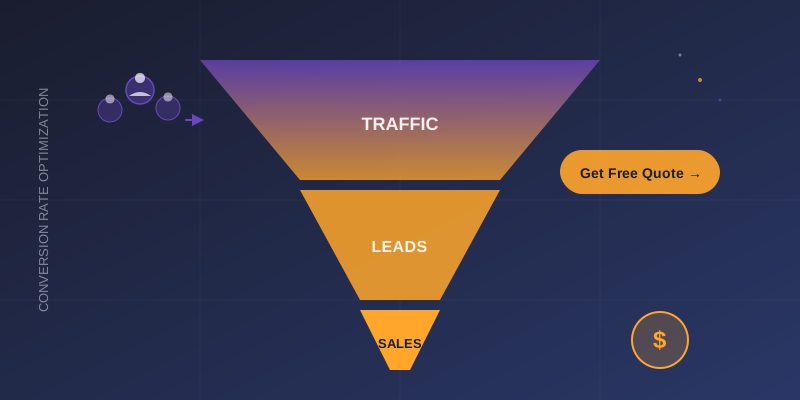
You spent real money on your website. The branding looks sharp, the animations feel modern, and everyone on your team gave it a thumbs up. Then the first quarter rolls by — and the inquiries aren't coming in. Visitors are showing up, but they're leaving without calling, without filling out a form, without doing anything.
This is the most common problem we see at BizmaTech when US small businesses come to us for help. The diagnosis is almost always the same: you don't have a traffic problem — you have a conversion problem. Fixing that is often faster and cheaper than running more ads.
1. Your Hero Section Fails the 3-Second Test
When someone lands on your homepage, they make a decision within three seconds: does this look like it's for me? Most small business websites fail this test because the headline describes the company ("Award-winning full-service digital solutions provider") instead of the customer's outcome ("Get a website that actually books you clients").
A strong hero section answers three questions instantly: What do you do? Who is it for? What should I do next? If your current headline is vague, self-congratulatory, or jargon-heavy, rewriting it is the single highest-ROI change you can make today.
2. Your Call-to-Action Is Hidden or Confusing
We audit dozens of small business websites every year, and the CTA problem is almost universal. The button blends into the background, says something passive like "Learn More," or it's buried below the fold where most visitors never scroll. Your CTA needs to be impossible to miss and impossible to misunderstand.
Use action language that names the outcome: "Get My Free Quote," "Book a 30-Min Call," or "See Our Pricing." Place a CTA in your hero section, after every major content block, and in your footer. Don't make the user work to figure out how to hire you.
3. Your Website Is Not Truly Mobile-Optimized
Over 60% of web traffic in the United States now comes from mobile devices. "Mobile responsive" and "mobile optimized" are not the same thing. A responsive site adjusts its layout — a mobile-optimized site is designed with thumbs, small screens, and 4G connections in mind from the start.
Common mobile failures we fix: tap targets that are too small, pop-ups that block content on phone screens, text that's too small to read without zooming, and horizontal scrolling. Any of these will cause a visitor to immediately leave and call your competitor instead.
4. You Have Zero Social Proof Near Your CTAs
Asking a stranger to spend money with you requires trust — and trust requires proof. Testimonials, Google review counts, case study thumbnails, client logos, and before/after results are not optional extras. They are essential, and they belong next to your calls-to-action, not buried on a separate "Reviews" page that no one visits.
For US local businesses especially, a Google Business Profile with 20+ reviews visible on your website can double your inquiry rate. People making local buying decisions rely heavily on peer reviews. Show them yours front and center.
5. Your Page Load Speed Is Silently Killing You
Google's data shows that 53% of mobile users abandon a page that takes more than 3 seconds to load. A one-second delay in page response can reduce conversions by 7%. For a business doing $500K/year in online revenue, that's $35,000 gone because of slow hosting or unoptimized images.
Use Google PageSpeed Insights to check your score for free. Common culprits are uncompressed images (anything over 200KB on a web page is a red flag), no browser caching, render-blocking JavaScript, and cheap shared hosting. If your site scores below 70 on mobile, speed is definitely costing you customers.
Where Do You Start?
Pick whichever of the five problems above you recognize first and fix that one this week. You don't need to overhaul your entire website to see results — targeted, strategic changes to high-traffic pages make the biggest difference fastest.
Need a professional second opinion? At BizmaTech, we build websites for US small businesses that are engineered to convert — not just to look good. Get a free conversion audit today.
Frequently Asked Questions
What is a good website conversion rate for a small business?
The average across industries is 2–5%. A well-optimized small business website should target 3–8%. If your rate is below 2%, your site likely has messaging or usability issues costing you customers daily.
How do I know if my website has a conversion problem?
Key signs: bounce rate above 60%, session time under 1 minute, and minimal form submissions despite steady traffic. Google Analytics shows all of this for free.
What is a CTA and why does it matter?
A CTA (Call to Action) tells visitors exactly what to do next — "Get a Free Quote" or "Book a Call." Without a clear, prominent CTA, visitors leave without acting. It's the highest-impact element on most business websites.
How long does it take to improve website conversions?
Quick wins — better CTAs, clearer headlines, mobile layout fixes — can show measurable results within 2–4 weeks. Larger structural changes typically take 1–3 months to show in analytics.
How much does CRO cost for a US small business?
Focused CRO projects start around $1,500–$5,000. Even a 1% conversion rate improvement can mean thousands in additional monthly revenue, making it one of the best investments a business can make.