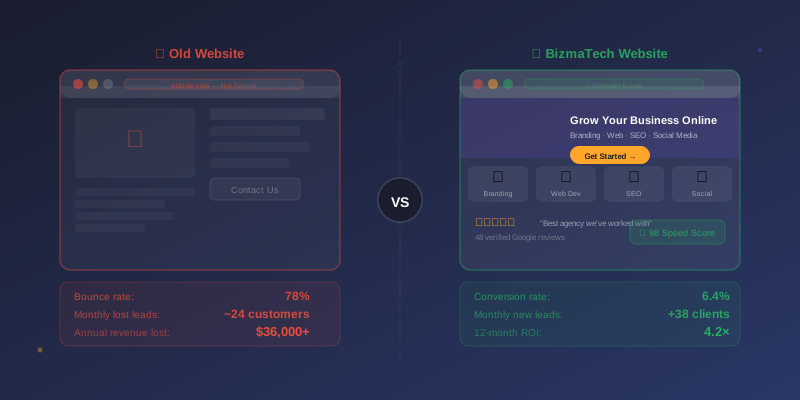
Most small business owners think of their website as a cost — a box to check, a digital business card. The uncomfortable truth is that your website is either the hardest-working salesperson on your team or a machine that is quietly turning away customers 24 hours a day. For most small businesses with outdated or poorly built websites, it is the latter, and the revenue cost is measurable.
Here is how to calculate what your website is actually costing you — and what a properly built site can realistically return.
The Conversion Rate Math Every Business Owner Should Know
Conversion rate is the percentage of website visitors who take the action you want — filling out a contact form, making a purchase, booking a call. The average conversion rate across industries is 2–3%. Well-designed, fast, and clearly structured websites convert at 4–8%. Poorly designed or slow sites often convert at under 1%.
Here is what that difference means in real revenue. Imagine your website gets 800 visitors per month and your average customer is worth $2,000 over their lifetime. At a 1% conversion rate, you get 8 leads per month. At a 4% conversion rate, you get 32 leads per month — with zero additional advertising spend. If you close 25% of leads, that is the difference between 2 new customers per month and 8 new customers per month, or roughly $12,000 in additional monthly revenue from the same traffic.
That is the real cost of a bad website: not the money you spent on it, but the money you are not making because it does not convert.
The Hidden Costs You Probably Are Not Measuring
Page speed penalties. Google data shows that a 1-second delay in mobile load time reduces conversions by up to 20%. A site that takes 5 seconds to load loses 40–60% of visitors before they ever see your services page. Run your site through Google PageSpeed Insights (free, takes 2 minutes). If your mobile score is below 70, this alone is costing you significant traffic and conversions. Most outdated or DIY-built websites score in the 20–40 range on mobile.
SEO invisibility. A poorly structured website does not rank on Google. No rankings mean no organic traffic — and organic traffic from Google is the only significant free customer acquisition channel available to a small business. Businesses with well-optimized websites generate 40–60% of their leads from organic search. If your website gets most of its traffic from direct visits and referrals only, you are leaving a substantial channel completely untapped.
Credibility cost. Studies show that 75% of consumers judge a company's credibility based on its website design. If your website looks outdated, loads slowly on mobile, or feels amateurish, a significant portion of people who find you through referrals or social media will quietly move on to a competitor who looks more professional — before they ever contact you. You will never know these customers were lost because they never appeared in your analytics.
The opportunity cost of DIY. Many small business owners maintain their own websites using website builders, spending hours every month updating content, troubleshooting issues, and trying to figure out SEO. At a conservative $75/hour opportunity cost (what that time could earn in billable work), even 4 hours per month of website maintenance is $3,600 per year of your time — often producing worse results than a professionally built site that handles itself.
The ROI Calculation: Is a New Website Worth It?
A professionally built small business website from BizmaTech typically costs $3,000–$12,000 depending on scope. Here is a realistic ROI scenario using conservative numbers:
Current state: 600 monthly visitors, 0.8% conversion rate = 4.8 leads/month. Close rate 30% = 1.4 new customers/month. Average customer value $1,500. Monthly revenue from website: ~$2,100.
After a professionally built website: same 600 monthly visitors (SEO improvements will grow this over time), 3.5% conversion rate = 21 leads/month. Close rate 30% = 6.3 new customers/month. Monthly revenue from website: ~$9,450.
The delta is $7,350 per month in additional revenue. A $6,000 website investment pays for itself in under 30 days of improvement and generates more than $88,000 in additional annual revenue at the same traffic volume. And that is before organic SEO improvements start compounding traffic growth.
What a High-Converting Small Business Website Actually Needs
The gap between a 1% converting website and a 4% converting website is almost never about design aesthetics. It comes down to five structural factors:
Clear above-the-fold value proposition. Visitors decide whether to stay within 3 seconds. Your homepage needs to answer in that window: who you are, what you do, and who you do it for — in plain language, not marketing jargon.
A single primary call to action. Most low-converting websites give visitors too many choices — a phone number, a contact form, a social link, a newsletter signup. Decision paralysis kills conversions. One primary CTA per page, repeated multiple times, consistently outperforms a menu of options.
Social proof placed strategically. Testimonials, case studies, and review counts placed near the conversion points (near CTAs, on service pages, before the contact form) consistently increase conversions by 15–40%.
Mobile-first design. Over 60% of small business website traffic comes from mobile devices. A site designed for desktop that "also works on mobile" is not the same as a site built mobile-first. Speed, tap targets, readable text, and accessible forms all need to be native to mobile, not retrofitted.
Local trust signals. For US local businesses, your address, phone number, service area, and reviews need to be visible and easy to find. Customers looking for a local provider are trying to confirm you are real, nearby, and trusted before they reach out.
If your current website is missing any of these, BizmaTech builds high-converting websites for US small businesses — with all five elements built in from day one. Get a free website audit and we will show you exactly what your current site is costing you.
Frequently Asked Questions
What is a good website conversion rate for a small business?
The average conversion rate across industries is 2–3%. A well-designed, fast, and clearly structured small business website can achieve 4–8%. If your current rate is below 1–2%, your website design, messaging, or page speed is costing you significant revenue.
How much does a new business website cost?
A professionally designed small business website typically costs $3,000–$15,000 depending on complexity. A well-built website pays for itself through improved conversion rates and organic search traffic, typically within 6–18 months.
How does page speed affect revenue?
A 1-second delay in mobile load time reduces conversions by up to 20%. A site loading in 5 seconds instead of 2 seconds can lose 40–60% of visitors before they see your content. Run Google PageSpeed Insights for a free diagnosis.
How do I know if my website is hurting my business?
Warning signs: bounce rate above 70%, session duration under 45 seconds, mobile load time over 3 seconds, conversion rate below 2%, or no contact form submissions despite steady traffic. Google PageSpeed Insights and Search Console provide free diagnostics.
What is the ROI of a new business website?
A business with 800 monthly visitors going from 1% to 4% conversion rate produces 4× more leads on identical traffic. For a business where each customer is worth $1,500, this can represent $80,000+ in additional annual revenue from the same traffic — often far exceeding the site's build cost in year one.